Showing posts with label Formations. Show all posts

Thursday, 2 June 2011

What makes Barcelona such a formidable team? - Part 2

Continuing on from part 1...

6. Lack of counterattacks

A particularly interesting feature of Barcelona’s attacking play is how often they turn down quick counterattacking opportunities from within their own half. If possession is regained inside the opposition half they will of course look to exploit the space (which ties in to the pressing game as will be discussed later), but box-to-box counters are a rare sight.

Rather than speed up the play on such occasions, Barcelona look to use the opportunity to regain shape and restart their patient passing game. This gives the opposition time to get men back behind the ball, and perpetuates a constant state of Barcelona being camped in their opponent’s half. With so many men back, the opposition have no out-ball and this enables Barcelona to suffocate them inside their own half. In addition, it avoids the game descending into an open, end-to-end battle where Barcelona may be susceptible to counter-counterattacks. (As was the case when Barcelona tried to force a quick goal in the last 10 minutes of their away match vs Arsenal this season).

A potential problem with this strategy is that by compressing all the play into the final 3rd of the pitch, Barcelona are effectively also shutting off their own space too. Normally this would be a hindrance to a passing side – Arsenal fans know all too well how frustrating it is to see a team knocking the ball harmlessly from side to side in front of a 9-man defence. But Barcelona are perhaps the best side in the world at functioning in tight spaces. Notice how many of the following team goals are scored by cutting though 8/9-man defences, especially from 2:20 – 4:15):


7. Tactical flexibility

Barcelona are often accused of lacking a plan B, but this ignores the fact that the plan A itself is versatile and allows for several different formations which take advantage of different areas of the pitch.

4-3-3 – Barcelona’s standard formation features 3 midfielders to control possession, a false 9 in the shape of Messi and 2 wide forwards making out-to-in runs.

3-4-3 v.1 – With Busquets dropping back in between Pique and Puyol, this allows the team to break free of aggressive pressing of the centre backs by opposition forwards. The fullbacks can then push on and provide width higher up the pitch, allowing the three forwards to narrow and link up with each other at close quarters.

3-4-3 v.2 – When Alves pushes forward on the right flank, Pique and Puyol shuttle over to the right, with Abidal tucking in off the left to become in effect a third centre back. The front three can again narrow, with Iniesta providing a more cut-inside wide threat on the left.

Diamond 4-4-2 – Against teams that look to match Barcelona’s trio in midfield, Messi can drop off to play as a no.10 on a more full-time basis. The opposition can either pull a man back to deal with him (freeing up space for one of Xavi or Iniesta), or ignore him and allow him space in between the lines to wreak havoc.

This versatility gives them a great advantage – they can shift easily between different shapes at any stage of the game, without having to waste any substitutions.

8. Dual-function players

Perhaps one of the greatest difficulties in replicating Barcelona’s system is that they have a couple of phenomenal players in Lionel Messi and Dani Alves who can essentially play in two positions at once.

Dani Alves is on paper a full-back, yet his incredible pace and stamina allows him to patrol a whole right flank by himself. You could say that his presence is like having an extra man, allowing Barcelona to play a 4-4-3 formation. Note how much of the pitch he covers in the heatmap below – almost the entire length and half the width:


In the attacking phase he’s one of the most potent wingers in the world (recording 12 goals and 48 assists in his last 3 seasons), in the defensive phase an aggressive presser. During opposition transitions, he can be seen hurtling back towards his own goal, making some fantastic last ditch tackles in the process (granted he does also get caught out on occasions, such is the risk of the role he plays): 


Although he was already a brilliant individual artist and an intelligent teamplayer, Lionel Messi’s redeployment to the “false 9” role mid-way through the 2009/2010 season allowed him and Barcelona to reach even greater heights. It was a tactical masterstroke from Pep Guardiola, who managed to find a way to make his side even more possession-orientated without losing any of the attacking potency that they’d had the previous season with Eto’o in the centre forward role.


The value of a false 9 usually lies in their ability to drop deep and link-up with the midfield, utilising good passing and ball control skills to control the ball tidily and maintain the flow of the attack. The theory is that centre backs – not being comfortable marking empty space – will advance forward and close down the false 9, creating space in behind for one of the wide forwards to run into. (Good example here)

The problem with such a tactic is that it relies on intelligent movement by the wide forwards, and the assumption that the centre backs will close down. If this doesn’t happen, the team can be left with no presence inside the box and no penetration.

However, this isn’t a problem with Lionel Messi in the false 9 role. He has the complete skillset as an attacking player, combining superb dribbling, passing and shooting into one devastating package. He can drop back into midfield and help to build attacks from deep, but his ability to accelerate and to dribble past players with ease means he’s never too far away from goal to not be a threat. He can poach goals; he can slalom his way through to goal; he can score from range; and he can provide defence-splitting passes. In the last 2 seasons, he has scored 15 goals from outside the box in open play, and provided 36 assists for teammates - wherever he is in the opposition half, he’s a threat.


9. Pressing

As well as being the best attacking side in Europe, Barcelona are probably also the strongest defensively. What they lack in conventional 18 yard box defending, they more than make up for with their aggressive pressing game higher up the pitch, stifling opposition attacks before they have a chance to come to fruition.

Barcelona’s pressing game is aided by several factors:

(a) They dominate possession high up the pitch, forcing the opposition to get men back behind the ball. With their opponents penned back inside their own half and lacking an outlet for pressure, Barcelona can often close in for the kill and either win the ball back quickly or force an aimless long ball which the defenders can sweep up easily.

(b) The majority of their passes tend to be short, so Barcelona’s players are nearly always in a position to press once play breaks down, as Johan Cruijff explains:
"Do you know how Barcelona win the ball back so quickly? It's because they don't have to run back more than 10 metres as they never pass the ball more than 10 metres."
(c) They conserve energy while in possession, enabling them to expend more while pressing. It’s often thought that Barcelona work harder than the average team, but their distance covered figures from this year’s Champions League are quite revealing. On average they covered 110.465 km per game, compared to 110.644 km by 2nd-placed Man Utd. This was less than the 112.040 km average of all teams in the competition. Barcelona’s season-high distance covered was 116.624 km, which was dwarfed by the overall competition high of 124.503 km. Clearly, the long periods spent playing a relatively low-intensity passing game help to balance out the high-intensity pressing.

So how does the pressing game actually work? Work rate is obviously one factor, but intelligence and organisation are very important too. It’s telling that Barcelona’s defensive record has improved with each passing season under Guardiola, as players have gained more experience and take up better positions while pressing:
2008/2009 – 35 league goals conceded, 55 conceded in 62 games overall
2009/2010 – 24 league goals conceded, 40 conceded in 59 games overall
2010/2011 – 21 league goals conceded, 38 conceded in 62 games overall
Barcelona have several different systems of pressing which they employ depending on which area of the pitch the ball is at.

When an opposition keeper or defender has the ball, one player (usually Villa or Pedro) will sprint at him and force him into rushing a pass, while the players behind him employ a system of through marking to cover all the nearby passing options. If they do it correctly, then the player should have no choice but to punt it long, allowing Barcelona’s defenders to read the flight of the ball and move in to intercept.

At 0:57 in the following video you can see this type of pressing in action. Pause it at exactly 1:09 and you will see that all 6 white shirts are being marked by nearby Barcelona players – the ball is hit long and possession is regained:


If you also skip to 2:00 in the video above, you can see a different type of pressing in action. When an opposition player has the ball close to the flank, Barcelona players will attempt to surround and outnumber him, suffocating him and stealing the ball. At the exact moment possession is stolen (around 2:12), Barcelona have 3 players ganging up on just 1 Real player.

A more dynamic type of pressing can be seen in the opening 30 seconds of the following video. With Espanyol passing quickly from point to point, Barcelona players have to take it in turns to close down the man on the ball (usually the one nearest by), with players from behind coming in to replace the previous marking duties of the presser:


Immediately after losing possession in the final third, the Barcelona players in close vicinity – no matter whether they’re a defender or attacker – will attempt to close down and win it back quickly (as can be seen in this video of the Arsenal-Barcelona tie at the Emirates last year). This form of pressing is perhaps the most aggressive, and least organised. Opponents who can bypass this first wave of pressure stand a chance of launching a successful counter.

10. Universality

One of the key concepts that underpins Barcelona’s positional fluidity is that every player should be comfortable operating in any part of the pitch, and contributing to the 3 main aspects of Barcelona’s game – defence, possession, and attack.

It’s not uncommon for instance to see Xavi dropping back to become the deepest outfield player on the pitch, popping up on the right flank, or advancing to the centre forward role when Messi drops deep.

Here’s a clip of Javier Mascherano dribbling into the opposition area from centre back (while Xavi takes over his position):


Here’s Pique scoring a goal from a marauding run forward:


Dani Alves making a trademark poacher-like run to score a header:


And best of all, the forward trio of Messi-Villa-Pedro defending like rabid dogs:


In Summary

Barcelona’s playing style owes a lot to the above principles, but without long-term grassroots investment it’s not possible for any single club to build a collection of footballers with the required technical skills to implement such a gameplan.

Team chemistry plays a big part too, and Barcelona’s core group of players have that in abundance. The likes of Xavi-Iniesta, Messi-Alves, and Pique-Puyol have had years (helped by a lack of rotation) to build up their understanding of each other’s movement and passing patterns, such that it has become second nature.

It’s likely that we may not see another Barcelona in our lifetime, so we should savour every moment of the current one while they’re still around.


Credit to allas4 for majority of videos.

Monday, 1 November 2010

Arsenal 1-0 West Ham: Analysis of Arsene's new-look midfield

For the 2nd Premier League game running, Arsene Wenger chose to field a Denilson-Song-Fabregas midfield three but unlike the City game last weekend, Arsenal had to make do with playing against the 11 men of West Ham in a fixture that has been quite tight and low-scoring in recent years.

As such, this was the first true test of this new midfield's ability to break down a deep-lying defensive team. A similar system was in place against Partizan with Denilson the deepest midfielder and Song more box-to-box, but on that occasion Jack Wilshere played as the attacking midfielder in place of the injured Cesc Fabregas. Wilshere was of course suspended for this fixture and the one at Eastlands, had he been available it's likely we may not have seen this novel midfield system in place.

Arsenal's midfield setup vs West Ham: Denilson (yellow) held, Fabregas (blue) attacked and Song (green) alternated in between. It should be noted though that Denilson was subbed off after 67 mins, after which Arsenal set up camp in the final 3rd. The average positions of Fabregas and Song may therefore appear to be higher up than they actually were while all 3 players were on the pitch together.

With Denilson holding the midfield and Fabregas supporting Chamakh in attack, Song was free to roam in between and contribute to both defence and attack. Much like Yaya Toure, Song is a player valued for his physical and defensive qualities but with the technical ability and intelligence to play higher up the pitch in a more direct and creative role. Potentially he's the best box-to-box player in the squad given his all-round abilities, intelligence and discipline (although Wilshere has also impressed so far this season), but the problem for Arsenal is that he's also by far the best holder. The question is which is better - Song holding/Denilson passing or Denilson holding/Song box-to-box? Wenger has opted for the latter in the last few games they've played together. Song brings added dynamism to the attack compared to Denilson, but at the same time still gets back to form a double defensive shield when the opposition have the ball in Arsenal's own half, so his re-deployment further forward may not necessarily weaken the defence.


Although each of the midfield trio had individual roles, there was considerable interchange with all 3 being comfortable playing deep or closer to the opposition box (Denilson less so). This seems to be a conscious decision by Arsene Wenger in an attempt to find new ways of breaking down the dreaded "parked bus" which has often been the scourge of this possession-based Arsenal side. With players moving out of their natural zones, they can lose their markers, draw players away from team-mates, and arrive un-noticed in dangerous areas. In particular, if the deepest midfielder - who often has no specific marker - is given the license to get into the opposition box, then that adds a whole new attacking dimension to this Arsenal side.

Of course this requires discipline and understanding between the midfielders in order not to leave the defence uncovered, this was painfully apparent against West Brom but on Saturday this didn't seem to be a problem.

As usual, some video evidence to summarise the key features of the new-look midfield:

Thursday, 16 September 2010

Arsenal 6-0 Braga Analysis

A fantastic display of flowing football from Arsenal, aided by an unusual formation and the deployment of teenager Wilshere in a deep midfield role. The Gunners continued their excellent form in the absence of Robin van Persie - unlike last season - thanks to Marouane Chamakh's typically intelligent play in the centre forward role, which bodes well for the rest of the season.

While Chamakh has been able to fill in for van Persie and perform a similar role as a false 9 within Arsenal's system, Theo Walcott does not have a direct replacement. Against Bolton Rosicky came in, while last night Nasri started in his place. Both are naturally central playmakers, and even though on paper they were playing on the right of Arsenal's 4-3-3, in reality they both drifted infield and acted as extra central midfielders when Arsenal were in possession. See the following average position graph:

The replacement of Walcott (a forward who naturally plays high and wide) with Nasri (a central playmaker) resulted in Arsenal's 4-3-3 morphing into a diamond 4-4-2 that was slanted to the left. Song held the midfield and covered the area in front of Sagna, while Wilshere protected Clichy but had more license to get forward. Fabregas played at the tip of the diamond and wreaked havoc in the final 3rd.

The skewing of the formation towards the left meant that Arsenal were able to focus their attacks down that side, as the following diagrams demonstrate:

Arsenal's attack chart, showing a clear preference for attacks down the left

Arsenal's shots (in yellow), the majority coming from the left

It was therefore no surprise that 5 of the goals (including the penalty) originated down the left side of the pitch, helped by some slack marking from Braga's right back, Miguel Garcia. Andrey Arshavin played a key role, scoring one, setting up two more and playing a part in another. Arshavin is often criticised for being wasteful in possession and in front of goal, but this is exactly what he's in the team for; not to give the ball away, but to be ambitious and expressive without having to feel restrained (within reason of course). His advanced role gives him freedom to try killer passes and shots more often than his teammates, and it's no surprise therefore that he gives the ball away more often than any other Arsenal player - but it also means that he's able to have a direct contribution to quite a lot of Arsenal goals. The same applies to Fabregas' role, to a lesser extent.

While shifting the formation to the left worked wonders for Arsenal, it did of course mean they were slightly vulnerable down the right. It didn't matter in the end though, Braga were guilty of not reacting to Arsenal's unsual formation. Faced with an overload down their right, they continued playing a symmetrical 4-3-3 and didn't look to shift their formation in response. In addition, they focussed their attacks down their right and didn't take advantage of Arsenal's exposed right flank. Braga's left flank was in effect underused, while their right flank was overworked.

Braga focussed the majority of their attacks down Arsenal's left via Alan,
instead of exploiting the Gunners' exposed right flank. In addition, centre
forward Matheus constantly made diagonal runs towards Arsenal's left.

Fabregas and Arshavin did most of the damage in the final 3rd, but they were aided greatly by the quick, accurate and incisive passing of Jack Wilshere. The young Englishman - playing as the link midfielder - was able to keep the ball circulating and to service the more attacking players throughout the game. He got forward often, bagging himself an excellent back-heeled assist for Chamakh's goal and playing an excellent ball over the top in the build-up to Vela's 2nd. He certainly offers something different to Diaby's counter-attacking and Denilson's tidiness, and Wenger often talks about the need for a cultured left footer to provide balance in the centre (think of the Vieira-Petit partnership).

With the intelligent passing of Wilshere from deeper, the probing of Fabregas from further up, and the extra presence of Nasri centrally, Arsenal were able to pass their way through the middle with more ease than they would normally do, and produced some scintillating football in the process. Notice how much Wilshere features in the following video:


This game will live long in the memory of Arsenal fans, and for Wenger, it was further vindication of his stubborn quest to produce a beautiful, yet successful brand of possession football.

Sunday, 12 September 2010

Marouane Chamakh - First Impressions

After just 4 games into the season, I have to say I'm really impressed by the Moroccan. When he was signed on a free in the summer, a lot of fans (Arsenal included) questioned his goalscoring record and some claimed he was no better than Bendtner. But there's so much more to his game than simply being a goal-getter.

One of the main things that stands out about Chamakh is his heading. According to OPTA, he scored 17 headed goals in his last 2 seasons at Bordeaux. He's scored twice so far for Arsenal and both have been headers. He possesses fantastic leaping and neck power, and he throws himself at the ball instead of waiting for it to come to him. We saw this in action during the very first game, when he challenged Reina for a high ball and resulted in the keeper fumbling the ball into his own net. That sort of aerial threat is needed against teams who pack the box, defending deep and narrow (as Spurs and Man City did last season, knowing that they'd clear any aerial balls into the box). Bendtner, as decent a header he is, is not on the same level as Chamakh in that regard.

The key to getting the best out of his heading is to deliver hanging balls into the 6 yard box close to the keeper. It takes the defenders out of the equation and leaves Chamakh to contest the keeper one-on-one in an aerial duel, which given his bravery, shouldn't be a problem. In the pre-season friendly against Legia we saw how this tactic could work when Nasri delivered a nice tempting ball in to the 6 yard box which forced the keeper to commit, allowing Chamakh to nip in and head past him.

He also offers an outlet for long passes when under pressure. His chest control and first touch are very tidy, and he's much more adept at winning flick-ons than any other striker currently at the club. At the moment the team hasn't yet adapted to take advantage of this, and it's tougher when you don't have a strike partner in close proximity. In time we should expect Fabregas/other attacking midfielder to make the necessary runs to get on the end of his knock-downs, as Gourcuff did for Bordeaux.

Setting aside his obvious aerial prowess, the biggest threat he offers in my opinion is his movement. It's just brilliant. You often hear fans reeling out the "he makes the other players around him play better" cliche when defending a non-prolific striker, but in Chamakh's case it really is true.

When Adebayor was sold a lot of Arsenal fans (myself included) were wondering how the team would cope without a real presence in the box, but what became apparent was that one wasn't necessary. With the 4-3-3 formation, the emphasis was on stretching the play and creating space for runners into the box, whether that be from midfield (Diaby, Fabregas) or from the wider areas (Arshavin, Walcott). Van Persie was brilliant as the centre forward because he dropped deep, drew centre backs out and created that space for others to run into. It was no coincidence that Arsenal averaged 2.9 goals a game with van Persie in the side and 1.8 with him out.

Chamakh is similar in style, but the main difference between the 2 is that in addition to dropping deep, Chamakh also loves to drift wide. Consequently the 2 wide forwards have enjoyed much more freedom to make diagonal runs inside. Chamakh and Walcott seemed to have built up a good understanding in pre-season, and against Blackpool Walcott was able to hit a hattrick thanks to Chamakh's movement. For the 1st goal, Chamakh drifted left, the whole Blackpool defence shifted in that direction, and space was opened up for Walcott to come inside. For Walcott's 2nd, Chamakh drifted to the right and Walcott took up his spot in the centre forward role. It wasn't as dynamic a move as the 1st goal, but it did demonstrate the understanding the 2 have in swicthing positions. When Walcott comes inside, Chamakh moves to the right to avoid congesting the space the in the box.

Against Blackburn, the 2nd goal was initiated by Chamakh dropping deep and picking up the ball on the half way line. A centre back followed him, space developed in the middle for Walcott to run into, the left back was dragged infield and Sagna had space to bomb into, creating a goal in the end.

With Walcott injured, Chamakh was able to turn his attentions to helping out Arshavin yesterday, and his constant runs to the left opened up gaps for Arshavin to run into. Unfortunately Arshavin missed all of his chances but the understanding and movement was there. For the Cahill sending off, where was Chamakh? On the left touchline, drawing defenders out of position towards him and backheeling the ball for Arshavin to run into space.
Last season the quality of Arsenal's play declined after van Persie was injured, the team was unable to play the same fluid football with Bendtner/Arshavin as the front man, and began to struggle against organised opposition at the Emirates, exactly the way they'd done the previous season. But in Chamakh, Arsenal now have a quality replacement for van Persie, a player who allows the team to play the same fluid system in his absence, albeit without the goalscoring capabilities of the Dutchman.

Monday, 30 August 2010

Blackburn 1-2 Arsenal Analysis

There was a lot of talk before the match about how Arsenal would cope with Blackburn's long ball and set piece-orientated style of football, particularly after comments made by both sets of managers. In the end it was fairly comfortable for the Gunners as they defended their box well and exposed Blackburn's lack of possession retention.

With the return of van Persie and Fabregas to the line-up, it was interesting to see how it would affect the (vaguely) 4-2-3-1 setup of the previous 2 games. Indeed there was a change with van Persie resuming his role as the "false 9", dropping deep to draw the centre backs with him, then looking to thread in the 2 wide forwards who made diagonal runs inside. Fabregas provided an additional threat, making plenty of forward runs to exploit the gap vacated by the Dutchman's movement, and on many occasions he found himself the furthest man forward.

Arsenal's brand of 4-3-3 - Van Persie (10) and his replacement Chamakh (29) dropped deep, the wide forwards played high up against the opposing full backs and Fabregas (4) constantly made runs beyond the centre forward. (The image is mirrored for some reason, Walcott was in fact playing on the right and Arshavin on the left, ditto Sagna and Clichy).

Van Persie departed after only 35 minutes but by then he'd already made his mark on the game, setting up Walcott for the opener with an excellent pass in between the opposing fullback and centre back. It was exactly the sort of goal that Arsenal's 4-3-3 formation facilitates, and with an intelligent runner like Walcott who's always looking to make that penetrating diagonal run, it should be a regular occurrence this season.

Van Persie was replaced by Chamakh, who performed a similar role. For the 2nd goal, Chamakh dropped back to the halfway line and spread the ball out to Sagna; meanwhile Walcott drifted into the centre forward role and drew the left back with him; this left Sagna with space to bomb forward and his cross found its way to Arshavin after Fabregas' shot had deflected off Walcott's rear end. Arshavin finished with typical finesse. Again, this was a goal made possible by the 4-3-3 formation, or rather Arsenal's version of the 4-3-3, in which the fullbacks bomb forward, the centre forward drops deep, and the wide-forwards make runs inside. It's all about movement and interchanging of positions, it confuses opponents and makes it harder to mark individual players.


As with the previous 2 games, the defending was again a strong point. Blackburn's long goal kicks and throws were handled with relative ease. Almunia came for the ball confidently, Koscielny and Vermaelen won many aerial balls, and Song was on hand to sweep up any spills.


According to OPTA, Arsenal won 55% of duels which is very impressive against a team that bases its game on aerial and physical superiority. It was a great display of collective commitment and should give Arsenal fans encouragement for the trip up to Stoke at the end of the season.

Tuesday, 24 August 2010

Arsenal 6-0 Blackpool Analysis

This game didn't reveal anything particularly new from an attacking point of view - Arsenal may have scored 6 goals but they were up against a newly-promoted side who were reduced to 10 men early on and failed to close down properly. It was too easy for Arsenal and unlike last week against Liverpool, the attack wasn't really tested with a watertight defence.

What we have learned over the last 2 games is that Arsenal have adopted a new defensive ethic this season, partly facilitated by a change in formation. Diaby and Wilshere continued to play deep, shielding the defence but also breaking forward on occasion to take advantage of the space afforded by Blackpool's lax marking. The 2 wide forwards pressed slightly higher than they did against Liverpool, giving Arsenal a much more natural 4-3-3 shape. As this average position diagram shows, the 3 forwards played on the same line, with Rosicky sitting just ahead of the 2 deep midfielders.

Arsenal's almost perfectly symmetrical 4-3-3

The most impressive aspect of the performance was the way Arsenal harried the opposition from start til finish, recording an amazing 33 interceptions in the process. Of those, 9 were made by the interception king Clichy, and 7 by Vermaelen, who's pro-active approach to defending was criticised last season following several costly positional errors.

Arsenal's 33 interceptions throughout the game,
concentrated along the left side of the pitch

And a video of the interceptions (in case you doubted the accuracy of the Guardian chalkboards!):


It's encouraging that the team maintained its' shape and width even against such lowly opposition (with all due respect to Blackpool). Diaby and Wilshere have struck up a good balance in the middle, but with Song returning and Wilshere unlikely to be a regular starter when everyone's fit, we might see a different system in place over the course of the season.

Tuesday, 17 August 2010

Liverpool 1-1 Arsenal Analysis

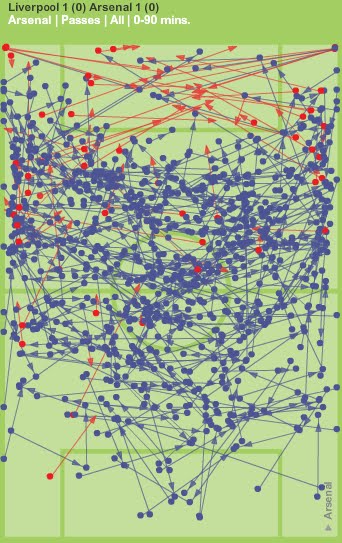
The draw against Liverpool was a typical Arsenal performance - dominate possession but struggle to create chances, concede a soft goal, try to pass your way through the resulting parked bus and finally grab a goal in injury time.

The same issues were present from the last few seasons attacking-wise. The build-up was too slow, there was a lack of width provided by the front players, and on the occasions that the fullbacks did get forward their crossing was generally wayward. On the plus side, Arsenal's defensive game seems to have improved in time for the new season and there's a return of the collective pressing that was evident at the start of last season.

First up, the lack of width. The 2 wide forwards Eboue and Arshavin constantly looked to come inside, Eboue in particular has a habit of cutting inside from the wing and embarking on marauding runs through the middle, congesting the area in front of the box and making it easy for the opposition simply to defend narrow.

Eboue and Arshavin take up central positions, with all 5 forward players crowded in a small zone

Eboue and Arshavin both central again
With the congestion of the central areas, you'd have expected the fullbacks to advance into crossing positions, but they were rather subdued in the 1st half, Clichy in particular saw very little of the ball in the attacking 3rd. Sagna got forward better, possibly due to Eboue's ability to drop back to cover the space vacated (which he did quite well), but none of his crosses threatened. Indeed, Arsenal struggled to produced quality crosses throughout the 90 minutes, even with one of Europe's best headers as a target inside the box.

Poor crossing throughout the game
Things improved in the 2nd half, partly through the introduction of Rosicky and partly because Arsenal had to throw the fullbacks forward in search of the equaliser to N'Gog's early goal. Rosicky provided a much-needed directness to the midfield, and his combination of quick, forward passes into feet and direct running helped create a little bit of space in the box for Nasri and Walcott to have shots (albeit blocked), and a golden chance for himself after getting past 2 defenders. His spreading of the play to the fullbacks also helped to stretch the play, although at this stage Liverpool were content to sit back with 8 men. In the end it was his cross that led to the own goal in the 91st minute, and it was the first time throughout the match that a player had found Chamakh inside the box with a cross (Walcott also did a couple of minutes later but Chamakh headed across the face of goal).

Rosicky's introduction added much-needed directness and penetration
that was somewhat lacking with Nasri as the primary playmaker
Defending-wise, it was an encouraging performance from Arsenal. In the defensive phase the formation loosely resembled a 4-4-1-1 with Diaby and Wilshere covering the space in front of the centre backs, and Eboue and Arshavin tracking back in the wide areas. The fullbacks were protected well although expecting someone like Arshavin to do that throughout a 50 game season is a bit of an ask.

Diaby and Wilshere in white, Eboue and Arshavin in black, Nasri in green, Chamakh in red
Same again
And again
Chamakh himself tracked back on occasions and was a vital component of Arsenal's team-based pressing game. Here's a short video highlighting Arsenal's recovery of possession and closing down of Liverpool defenders to prevent them passing the ball out from the back.


Putting the performance into perspective (key attacking players still to return), if the team can maintain this sort of defensive ethic throughout the season (unlike last year) then there is a good chance the 5 year trophy drought may end come May. Here's hoping.

Thursday, 20 May 2010

Arsenal's 4-3-3, Part 2

Carrying on from part 1, this video more than anything shows what Arsenal missed while van Persie was out injured for 5 months.

Saturday, 15 May 2010

Arsenal's 4-3-3, Part 1

A short video which shows how Arsenal's new 4-3-3 formation at the start of this season enabled the team to play more fluent and ultimately high-scoring attacking football.