Showing posts with label Premier League. Show all posts

Monday, 9 May 2011

Stoke 3-1 Arsenal: Chalkboards

For the 3rd time in four visits to Stoke since 2008, Arsenal have ended up on the losing side and yet again after going behind to an early set piece goal. Here are a few interesting chalkboards courtesy of the Guardian.

Clearances

Stoke were quicker to the second ball throughout, recovering possession with 27 of their 38 clearances (71%). The home team were constantly able to break out of danger zones, and consequently Arsenal were unable to exert extended pressure on Stoke's backline.

Arsenal on the other hand only managed 10 successful clearances out of 26 (38%). This proved costly when Walters scored Stoke's 3rd to kill the game off, pouncing on a poor clearance from Djourou before any Arsenal defender could react.


Interceptions

Stoke's interception chalkboard sums up their defensive strategy well. They were quick to get men back behind the ball (Arsenal's tempo also played a part), defending their 18 yard line well and looking to block Arsenal's passing lanes through the middle. Overall they made 20 interceptions to Arsenal's 12. Only 1 of them was in Arsenal's half, though it proved vital - Pennant latched onto Ramsey's lazy backpass and exploited the space in between the lines to fire in Stoke's second.


Stoke's passing

As with most opposition sides, Stoke targetted Arsenal's left flank, which was even weaker than usual due to Clichy's absence. Kieran Gibbs had an average game, and for Stoke's 3rd goal he failed to deal with a diagonal ball out wide, allowing Stoke to build an attack down that side and score.


See 0:45 in the following video: (credit to Arsenalist)

                      stok2131h68 by arsenalist

Laurent Koscielny

In general Koscielny has been a very good performer this season, forming a good understanding with Djourou and doing an excellent job in closing down opposition attackers early.

When playing a high line his value cannot be questioned, but when forced to defend inside his own 18 yard box he has displayed a certain level of vulnerability. His natural game is to win the ball early, getting tight and  nicking the ball away with an out-stretched leg, but inside the box this approach is something of a liability. Therefore, when defending deep he has at times been reckless, trying to win the ball at all costs and leaving gaps/conceding several penalties in the process. At other times he's been unsure of himself, wary of conceding fouls but not understanding some of the positional requirements of defending deep/soaking up opposition pressure.

This flaw to his game was evident again during Stoke's 3rd goal (skip to 0:50 in the above video), where he chased the ball out of the box and in the process ended up leaving a gap for Walters to exploit a couple of seconds later (granted it was a poor clearance from Djourou).


2nd half substitutions

At the start of the 2nd half, Wenger threw on Bendtner and Chamakh, giving Arsenal a very attacking 4-4-2 shape with Bendtner coming in off the left. Van Persie dropped deeper and Chamakh assumed the centre forward role, looking to play with his back to goal as usual. The Morroccan completed 26 out of 29 passes, and won 3 out of 4 tackles, adding a different dimension to Arsenal's attack.

This gave van Persie much more freedom than he had in the first half (where he only recorded 1 shot). After the break he managed to fire away 4 shots, 3 of them on target (including the goal) - all straight down the middle.


Chamakh was vital in creating space for van Persie. His tendency to drop deep, control it neatly (the Morroccan has a great touch, which is often overlooked) and lay the ball off quickly - drawing a marker towards him in the process - was very useful, and led to 2 great chances for the Dutchman, one of them a goal.


The first was on 73 minutes - Chamakh controlled the ball well from a goal kick, drew Stoke's right back out, and laid it off to Wilshere. Wilshere spotted the gap in behind Wilkinson and threaded the ball into the space for Bendtner, creating a golden chance for van Persie which was saved at point-blank range. See the following video:

                      stokrvpchance467 by arsenalist

The goal (see first video) was a culmination of the effect of the 3 Arsenal substitutes. Rosicky - twisting, turning and probing as usual - played a good forward pass between the lines. Chamakh, with his back to goal and drawing the attentions of Wilkinson, flicked the ball quickly to van Persie. Bendtner made a run to the left, dragging a centre back with him and giving van Persie enough room to fire away his 6th right-footed goal of the season.

Unfortunately the comeback was short-lived, but the one positive that can be taken out of this game (as with the 2-2 draw against West Brom and 2-1 win over Everton) is that a modified, attacking 4-4-2 is a decent plan B.

Saturday, 1 January 2011

Mid-season analysis: What's wrong with Arsenal's central defence?

We're exactly half way through the Premier League season and after another 2 cheap points were dropped at Wigan recently, it's worth exploring what's going wrong at the heart of Arsenal's defence, especially when it's occupied by the French pair of Laurent Koscielny and Sebastian Squillaci. The goalkeeper and left back situations have been scrutinised in great detail by Arsenal fans but the purpose of this article will be to examine the centre backs alone through a combination of statistical and video analysis.

For the sake of a fair comparison, Champions League and League Cup games will be ignored due to the weakened nature of the teams fielded. Tackles and interceptions made by centre backs in the final 3rd of the pitch will be excluded from the stats as these generally only occur during corner kick situations and do not reflect defensive ability. The 3rd goal conceded against West Brom in the 2-3 home defeat will also be ignored as the team was playing a 3-man defence from the 66th minute onwards (tackles/interceptions/shots during that time will also be ignored).

Partnerships

Firstly, let's take a look at the defensive efficiency of the 5 different centre backs pairings that have been fielded during the Premier League campaign so far:

Table 1: Centre back statistics for all 19 Premier League games to date

The Djourou-Koscielny and Song-Vermaelen partnerships have had little game time so can be ignored from this comparison. With that in mind the key points are that:

-The Koscielny-Squillaci pairing is the leakiest and concedes goals at almost 4 times the rate of the most secure pairing, Djourou-Squillaci.
-Despite conceding the least goals, the Djourou-Squillaci partnership actually concedes the most total shots and the 2nd most shots on target.
-The Koscielny-Squillaci partnership concedes fewer total shots than any other partnership, but the most shots on target.
-The Koscielny-Vermaelen pairing concedes the fewest total shots and the fewest shots on target.

These stats are for all Premier League games and so do not take into account the differences between home games and away games (where defences generally come under extra attacking pressure). Therefore here is a further breakdown of these stats beginning with home games:

Table 2: Centre back statistics for all 9 Premier League home games to date

From this table the only 2 partnerships worth comparing are Djourou-Squillaci and Koscielny-Squillaci. Again, key points are that:

-The Djourou-Squillaci pairing is the most secure and concedes goals at almost 3 times a lower rate than Koscielny-Squillaci.
-The Djourou-Squillaci partnership concedes more total shots and more shots on target than Koscielny-Squillaci.

And finally the away performances:

Table 3: Centre back statistics for all 10 Premier League away games to date

Key points here are that:

-Djourou-Squillaci once again emerges as the most secure pairing, despite conceding the most total shots.
-Koscielny-Squillaci is the least secure and concedes the most shots on target (as opposed to the least in home performances).
-Koscielny-Vermaelen concedes the least total shots and the least shots on target.

With the exception of shots on target conceded by Koscielny-Squillaci, the pattern of home and away games is quite similar.

Individuals

So what is the reason behind these trends? To understand we need to take a closer look at the strengths and weaknesses of each individual centre back, so that we can recognise the dynamics of each separate pairing. Here are individual stats for interceptions, aerial duels and tackling:

Table 4: Individual defensive stats for the 4 centre backs

The points we can draw from this are that:

-Koscielny is the most pro-active defender, attempting the most tackles and aerial duels, and the 2nd most interceptions. His tackling is by far the tidiest.
-Squillaci prefers to keep his position rather than close down, attempting fewer interceptions, aerial duels and tackles.
-Vermaelen and Djourou are somewhere in between these 2 varying styles, Vermaelen tending more towards Koscielny's game while Djourou is more akin to Squillaci.
-Despite attempting the most aerial duels, Koscielny is joint weakest in this area along with Squillaci (who attempts by far the fewest).
-Vermaelen is the strongest in the air, with Djourou not far behind.

Conclusion:

With this knowledge, we can roughly rank the centre backs in 2 important areas of the game:

Closing down:
Koscielny = Vermaelen > Djourou = Squillaci

Aerial ability:
Vermaelen > Djourou > Koscielny = Squillaci

This helps us to better understand the dynamics of each centre back pairing:

-Koscielny-Vermaelen concedes the fewest shots on target because it closes down the best and thwarts attacks before they develop (with a larger sample size it could possibly rank the lowest in terms of total shots too).
-The Djourou-Squillaci partnership concedes the most total shots because it doesn't close down (it is joint worst for shots on target too).
-The Koscielny-Squillaci pairing is the leakiest because it is weak in the air and therefore vulnerable from aerial balls and set pieces.
-The Djourou-Squillaci pairing is the strongest because it is deep-lying and doesn't risk being caught high up the pitch. Instead it looks to soak up opposition pressure, taking advantage of Djourou's aerial ability.

The major anomaly within these stats is that the Koscielny-Squillaci partnership concedes few total shots (due mainly to Koscielny's closing down?) but concedes the most shots on target and indeed the most goals (by a large distance). If the partnership restricts opposition shots so much, why then do a high proportion of these end up on target and in the net?

Comparing the Squillaci-Djourou and Squillaci-Koscielny partnerships, it's difficult to comprehend that the vast difference in defensive efficiency is down to a simple difference in defensive strategy. The fact that replacing Johan Djourou with Laurent Koscielny results in an almost 4-fold increase in goals being conceded, should be cause for concern, and points the finger of blame at the young Frenchman.

So what exactly is Koscielny doing wrong? It could be that he struggles on the left side of defence when partnered with Squillaci, as opposed to the more natural right-sided role he assumes when partnered with Vermaelen. Another factor may be that without the comfort of a Premier League-experienced partner, Koscielny lacks the right support and leadership to effectively function within this defence.

Another more simple explanation would be that Laurent Koscielny is simply error-prone, and that despite all his good work in getting tight to opponents and winning the ball back early, he lets it all go to waste with one or two moments of madness each match, whether it's a positional or technical error.

As usual, this pattern is best demonstrated with actual graphic evidence from the matches. The following video breaks down the 21 goals conceded in the Premier League campaign so far (excluding the 3rd against West Brom), and we can observe that indeed the main problems of the Squillaci-Koscielny partnership are its aerial weakness and Koscielny's tendency to make costly mistakes:


Solution:

So what can be done to remedy the current situation? The obvious decision would be to drop Koscielny in the short term and persist with the Squillaci-Djourou partnership, certainly in away games anyway. At home Koscielny's style of play would be beneficial towards Arsenal's pressing game and he can compete with Squillaci to partner the excellent Djourou (and when fit, Vermaelen).

In the long term, with more Premier League and general defensive experience, Koscielny should mature into a fine modern centre back, combining his excellent technical qualities and intelligence with improved concentration and reliability. It will be of great interest to see which two of Djourou, Koscielny and Vermaelen will establish themselves as the club's first choice centre backs given their similar ages and differing qualities.

Tuesday, 28 December 2010

Arsenal 3-1 Chelsea - Wenger gets his tactics spot on

After 13 failed attempts, Arsenal have finally beaten a Chelsea side containing Didier Drogba. Arsene Wenger spoke about the threat posed by the Ivorian before the game, and refreshingly his team selection was geared as much towards nullifying Chelsea as it was towards aiding Arsenal's passing game.

Wenger had several big selection decisions to make and he got all of them spot on:
-Johan Djourou came in for Sebastian Squillaci, adding more physical and aerial presence against Drogba
-A fully-fit Robin van Persie was preferred to Marouane Chamakh and resumed his role as a false 9
-Theo Walcott started on the right to reduce Ashley Cole's influence and provide a threat in behind Chelsea's defence
-Samir Nasri's work rate and economy in possession was preferred on the left with the more lackadaisical Andrey Arshavin dropped to the bench


Arsenal's 4-2-3-1: Song (17) and Wilshere (19) sat behind the front four, covering the right and left flanks respectively.
Van Persie (hidden behind 2) played his usual false 9 role, dropping back into midfield & creating space for Fabregas (4) and Walcott (14) to advance into the box. Koscielny (6) brought the ball out of defence while Djourou (20) stayed back.

In the same fixture last year, Ashley Cole set up two goals from left wing crosses and repeated the feat again at Stamford Bridge this season when he set up Didier Drogba for the opener. In both games Nasri started ahead of Walcott on the right, and the latter goal arose as a direct result of Nasri failing to track Cole's run down the left. Walcott played in the return fixture at Stamford Bridge last season and managed to keep Cole reasonably quiet, so perhaps Wenger had this in mind when deciding to start the young Englishman on the right.

In theory it makes a lot of sense, Walcott has tremendous pace and his diagonal running in behind opposition defences is a major threat - one which requires left backs to play more conservatively. This was the case in the game last night, with Cole barely venturing into the final 3rd of the pitch. Not only did Walcott pin back Cole for the majority of the time he was on the pitch, he also displayed excellent defensive awareness in tracking the runs of the left back (and of Malouda) on the few occasions that space did develop on Chelsea's left side - as this following video shows:


Ashley Cole's passing chalkboard: In the 73 minutes that Walcott was on the pitch, Ashley Cole managed just one (unsuccessful) pass in the attacking 3rd.

Walcott will have got a lot of plaudits for his role in Arsenal's 2nd and 3rd goals but his defensive work was equally excellent. With Cole/Malouda on the left and Ferreira/Kalou on the right, it's clear which side was Chelsea's strongest, and indeed there was a clear passing bias to the left throughout the match.  Walcott's defensive diligence - along with Bakary Sagna and Alex Song's excellent performances - helped to shut down Chelsea's entire left flank.

Arsenal's right-sided dominance: Alex Song (6/6) and Bakary Sagna (5/5)
completed all of their attempted tackles.

Chelsea's left flank shut down: Despite showing a clear preference for passing to the left flank, Chelsea were unable to penetrate into the final 3rd on that side - amazingly not a single pass was played from that zone. They had better luck down the right against the defensively-weaker trio of Clichy-Wilshere-Nasri, but Kalou and Ferreira lacked the ability to take advantage, and their teammates didn't seem to have much faith in them.

Not only did Arsenal defend well in their own half, they also pressed well in Chelsea's. Up until the 3rd goal, Chelsea's keeper and centre backs were put under constant pressure by the closing down of van Persie and Fabregas (and occasionally the 2 wider players), with the fullbacks and deeper midfielders pushing up to close down the gaps in behind. This was a much more co-ordinated form of pressing than has been seen in recent weeks from this Arsenal side, and it paid dividends. Chelsea were unable to build from the back and resorted to numerous long balls forward, which the Arsenal back 4 dealt with fairly comfortably. In addition, Arsenal were able to win back possession several times inside Chelsea's own half, the most prominent example being Walcott's robbing of Malouda in the build-up to Arsenal's 3rd goal.


While the defending was excellent, there was still the small matter of breaking through Chelsea's deep-lying defence. It's been a problem area for Arsenal in recent encounters between the two sides, with Chelsea keeping clean sheets in each of the previous 3 games. But this time it was to be different. In an attempt to break down stubborn defences, Wenger has given Alex Song more license to get forward this season (facilitated by a change in the midfield set-up from a 1-2 to more of a 2-1). The decision paid off against West Ham, and it did again yesterday as the Cameroonian started off an attack from deep, driving into the box before calmly shooting into the far left corner of the net.

In fact, Wenger will have been delighted with all 3 goals yesterday because they were a perfect demonstration of his attacking philosophy, and of the capabilities of Arsenal's 4-2-3-1/4-3-3 formation:


Overall, a very positive performance for the Gunners. Not only does it keep them in touch with the league leaders, it also provides a tactical blueprint with which to approach future big games. One of my main criticisms of Wenger has been that, while he may be an expert technician, he is not necessarily an expert tactician. On last night's evidence I am beginning to believe he may also be the latter.

Monday, 1 November 2010

Arsenal 1-0 West Ham: Analysis of Arsene's new-look midfield

For the 2nd Premier League game running, Arsene Wenger chose to field a Denilson-Song-Fabregas midfield three but unlike the City game last weekend, Arsenal had to make do with playing against the 11 men of West Ham in a fixture that has been quite tight and low-scoring in recent years.

As such, this was the first true test of this new midfield's ability to break down a deep-lying defensive team. A similar system was in place against Partizan with Denilson the deepest midfielder and Song more box-to-box, but on that occasion Jack Wilshere played as the attacking midfielder in place of the injured Cesc Fabregas. Wilshere was of course suspended for this fixture and the one at Eastlands, had he been available it's likely we may not have seen this novel midfield system in place.

Arsenal's midfield setup vs West Ham: Denilson (yellow) held, Fabregas (blue) attacked and Song (green) alternated in between. It should be noted though that Denilson was subbed off after 67 mins, after which Arsenal set up camp in the final 3rd. The average positions of Fabregas and Song may therefore appear to be higher up than they actually were while all 3 players were on the pitch together.

With Denilson holding the midfield and Fabregas supporting Chamakh in attack, Song was free to roam in between and contribute to both defence and attack. Much like Yaya Toure, Song is a player valued for his physical and defensive qualities but with the technical ability and intelligence to play higher up the pitch in a more direct and creative role. Potentially he's the best box-to-box player in the squad given his all-round abilities, intelligence and discipline (although Wilshere has also impressed so far this season), but the problem for Arsenal is that he's also by far the best holder. The question is which is better - Song holding/Denilson passing or Denilson holding/Song box-to-box? Wenger has opted for the latter in the last few games they've played together. Song brings added dynamism to the attack compared to Denilson, but at the same time still gets back to form a double defensive shield when the opposition have the ball in Arsenal's own half, so his re-deployment further forward may not necessarily weaken the defence.


Although each of the midfield trio had individual roles, there was considerable interchange with all 3 being comfortable playing deep or closer to the opposition box (Denilson less so). This seems to be a conscious decision by Arsene Wenger in an attempt to find new ways of breaking down the dreaded "parked bus" which has often been the scourge of this possession-based Arsenal side. With players moving out of their natural zones, they can lose their markers, draw players away from team-mates, and arrive un-noticed in dangerous areas. In particular, if the deepest midfielder - who often has no specific marker - is given the license to get into the opposition box, then that adds a whole new attacking dimension to this Arsenal side.

Of course this requires discipline and understanding between the midfielders in order not to leave the defence uncovered, this was painfully apparent against West Brom but on Saturday this didn't seem to be a problem.

As usual, some video evidence to summarise the key features of the new-look midfield:

Monday, 27 September 2010

Arsenal 2-3 West Brom - A Comedy of Errors

Not much to say about this defeat really, for 70 mins Arsenal put on a textbook display of how to lose a football match in a game that they were really expected to win quite comfortably.

Some grim stats:

-Eboue completed 8/15 passes in 56 minutes

-3/10 of Arshavin's corners found a teammate

-Nasri completed 1 pass into the box (a corner)

-Song won 5/11 tackles

-Eboue and Rosicky attempt 0 tackles; Koscielny and Diaby lost the 2 tackles they each attempted

-Clichy lost 6/7 aerial duels

-Nasri attempted 10 shots; the next highest was Sagna with 4; Chamakh and Arshavin managed 3 apiece in 90 minutes

-West Brom had 5 shots on target during the match, they scored from 3 of them; Arsenal had 6 shots on target despite having 30% more possession

-Arsenal conceded 2 goals within the space of 3 minutes
_____________

Sit back and admire the incompetence on display:

Monday, 13 September 2010

Analysis of Chamakh's movement vs Bolton

Following on from the post yesterday about Chamakh's first few games at Arsenal, here is a very short analysis of Chamakh's movement in the 4-1 win against Bolton and how it created space for others to exploit, particularly Arshavin.

Monday, 30 August 2010

Blackburn 1-2 Arsenal Analysis

There was a lot of talk before the match about how Arsenal would cope with Blackburn's long ball and set piece-orientated style of football, particularly after comments made by both sets of managers. In the end it was fairly comfortable for the Gunners as they defended their box well and exposed Blackburn's lack of possession retention.

With the return of van Persie and Fabregas to the line-up, it was interesting to see how it would affect the (vaguely) 4-2-3-1 setup of the previous 2 games. Indeed there was a change with van Persie resuming his role as the "false 9", dropping deep to draw the centre backs with him, then looking to thread in the 2 wide forwards who made diagonal runs inside. Fabregas provided an additional threat, making plenty of forward runs to exploit the gap vacated by the Dutchman's movement, and on many occasions he found himself the furthest man forward.

Arsenal's brand of 4-3-3 - Van Persie (10) and his replacement Chamakh (29) dropped deep, the wide forwards played high up against the opposing full backs and Fabregas (4) constantly made runs beyond the centre forward. (The image is mirrored for some reason, Walcott was in fact playing on the right and Arshavin on the left, ditto Sagna and Clichy).

Van Persie departed after only 35 minutes but by then he'd already made his mark on the game, setting up Walcott for the opener with an excellent pass in between the opposing fullback and centre back. It was exactly the sort of goal that Arsenal's 4-3-3 formation facilitates, and with an intelligent runner like Walcott who's always looking to make that penetrating diagonal run, it should be a regular occurrence this season.

Van Persie was replaced by Chamakh, who performed a similar role. For the 2nd goal, Chamakh dropped back to the halfway line and spread the ball out to Sagna; meanwhile Walcott drifted into the centre forward role and drew the left back with him; this left Sagna with space to bomb forward and his cross found its way to Arshavin after Fabregas' shot had deflected off Walcott's rear end. Arshavin finished with typical finesse. Again, this was a goal made possible by the 4-3-3 formation, or rather Arsenal's version of the 4-3-3, in which the fullbacks bomb forward, the centre forward drops deep, and the wide-forwards make runs inside. It's all about movement and interchanging of positions, it confuses opponents and makes it harder to mark individual players.


As with the previous 2 games, the defending was again a strong point. Blackburn's long goal kicks and throws were handled with relative ease. Almunia came for the ball confidently, Koscielny and Vermaelen won many aerial balls, and Song was on hand to sweep up any spills.


According to OPTA, Arsenal won 55% of duels which is very impressive against a team that bases its game on aerial and physical superiority. It was a great display of collective commitment and should give Arsenal fans encouragement for the trip up to Stoke at the end of the season.

Tuesday, 24 August 2010

Arsenal 6-0 Blackpool Analysis

This game didn't reveal anything particularly new from an attacking point of view - Arsenal may have scored 6 goals but they were up against a newly-promoted side who were reduced to 10 men early on and failed to close down properly. It was too easy for Arsenal and unlike last week against Liverpool, the attack wasn't really tested with a watertight defence.

What we have learned over the last 2 games is that Arsenal have adopted a new defensive ethic this season, partly facilitated by a change in formation. Diaby and Wilshere continued to play deep, shielding the defence but also breaking forward on occasion to take advantage of the space afforded by Blackpool's lax marking. The 2 wide forwards pressed slightly higher than they did against Liverpool, giving Arsenal a much more natural 4-3-3 shape. As this average position diagram shows, the 3 forwards played on the same line, with Rosicky sitting just ahead of the 2 deep midfielders.

Arsenal's almost perfectly symmetrical 4-3-3

The most impressive aspect of the performance was the way Arsenal harried the opposition from start til finish, recording an amazing 33 interceptions in the process. Of those, 9 were made by the interception king Clichy, and 7 by Vermaelen, who's pro-active approach to defending was criticised last season following several costly positional errors.

Arsenal's 33 interceptions throughout the game,
concentrated along the left side of the pitch

And a video of the interceptions (in case you doubted the accuracy of the Guardian chalkboards!):


It's encouraging that the team maintained its' shape and width even against such lowly opposition (with all due respect to Blackpool). Diaby and Wilshere have struck up a good balance in the middle, but with Song returning and Wilshere unlikely to be a regular starter when everyone's fit, we might see a different system in place over the course of the season.

Tuesday, 17 August 2010

Liverpool 1-1 Arsenal Analysis

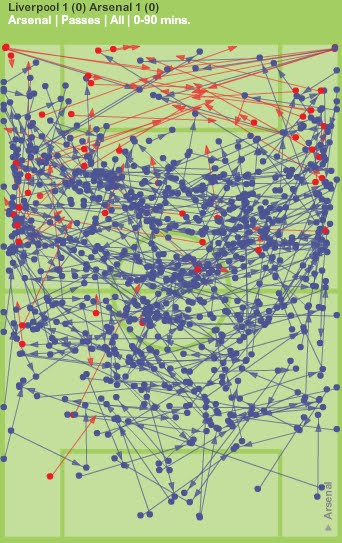
The draw against Liverpool was a typical Arsenal performance - dominate possession but struggle to create chances, concede a soft goal, try to pass your way through the resulting parked bus and finally grab a goal in injury time.

The same issues were present from the last few seasons attacking-wise. The build-up was too slow, there was a lack of width provided by the front players, and on the occasions that the fullbacks did get forward their crossing was generally wayward. On the plus side, Arsenal's defensive game seems to have improved in time for the new season and there's a return of the collective pressing that was evident at the start of last season.

First up, the lack of width. The 2 wide forwards Eboue and Arshavin constantly looked to come inside, Eboue in particular has a habit of cutting inside from the wing and embarking on marauding runs through the middle, congesting the area in front of the box and making it easy for the opposition simply to defend narrow.

Eboue and Arshavin take up central positions, with all 5 forward players crowded in a small zone

Eboue and Arshavin both central again
With the congestion of the central areas, you'd have expected the fullbacks to advance into crossing positions, but they were rather subdued in the 1st half, Clichy in particular saw very little of the ball in the attacking 3rd. Sagna got forward better, possibly due to Eboue's ability to drop back to cover the space vacated (which he did quite well), but none of his crosses threatened. Indeed, Arsenal struggled to produced quality crosses throughout the 90 minutes, even with one of Europe's best headers as a target inside the box.

Poor crossing throughout the game
Things improved in the 2nd half, partly through the introduction of Rosicky and partly because Arsenal had to throw the fullbacks forward in search of the equaliser to N'Gog's early goal. Rosicky provided a much-needed directness to the midfield, and his combination of quick, forward passes into feet and direct running helped create a little bit of space in the box for Nasri and Walcott to have shots (albeit blocked), and a golden chance for himself after getting past 2 defenders. His spreading of the play to the fullbacks also helped to stretch the play, although at this stage Liverpool were content to sit back with 8 men. In the end it was his cross that led to the own goal in the 91st minute, and it was the first time throughout the match that a player had found Chamakh inside the box with a cross (Walcott also did a couple of minutes later but Chamakh headed across the face of goal).

Rosicky's introduction added much-needed directness and penetration
that was somewhat lacking with Nasri as the primary playmaker
Defending-wise, it was an encouraging performance from Arsenal. In the defensive phase the formation loosely resembled a 4-4-1-1 with Diaby and Wilshere covering the space in front of the centre backs, and Eboue and Arshavin tracking back in the wide areas. The fullbacks were protected well although expecting someone like Arshavin to do that throughout a 50 game season is a bit of an ask.

Diaby and Wilshere in white, Eboue and Arshavin in black, Nasri in green, Chamakh in red
Same again
And again
Chamakh himself tracked back on occasions and was a vital component of Arsenal's team-based pressing game. Here's a short video highlighting Arsenal's recovery of possession and closing down of Liverpool defenders to prevent them passing the ball out from the back.


Putting the performance into perspective (key attacking players still to return), if the team can maintain this sort of defensive ethic throughout the season (unlike last year) then there is a good chance the 5 year trophy drought may end come May. Here's hoping.

Monday, 10 May 2010

Premier League Statistics 2009/2010

As the curtain draws on another Premier League season, I thought I'd take a look at some of the best individual performers throughout the campaign. (courtesy of OPTA statistics)


On the goal front, Didier Drogba capped an excellent season with a final-day hat trick to seal the Golden Boot ahead of Wayne Rooney. Impressively, only 1 of his 29 goals came from penalties, compared to Rooney, Bent and Tevez' 5 penalty goals and Lampard's incredible haul of 10 from the spot. Accuracy-wise, Bent was the most clinical of the top 5 scorers, while Torres demonstrated once again that he is one of the best finishers in the world, netting from 29% of his shots (Adebayor with 30% topped the charts).

Unsurprisingly, Javier Mascherano topped the tackles won column with an incredible 81% tackle success rate. He is one of the world's leading midfield destroyers and his form has been one of the few bright spots in a very disappointing season for Liverpool.

Liverpool, Wigan and Aston Villa dominate the top of the charts but this doesn't necessarily translate into solid defence on the pitch, in fact Wigan have the 2nd worst defensive record in the top flight this season (79 goals conceded).

Interestingly, Carlos Cuellar is the only defender to feature at the top, his aggressive approach may be one of the reasons Villa have managed to keep such an excellent defensive record this season (Chelsea game aside).


Onto the creativity columns, and Lampard has without doubt been the most creative player in the league this season, creating the most chances (for the 2nd season running) and setting up the most goals directly. Fabregas is behind in 2nd and has missed a fair few games through injury but it's testament to Lampard's fitness that he has managed 36 games at the age of 31. He's an incredible athlete.

Kevin Davies' presence is a surprise but when you consider how many aerial balls he wins and how well he holds the ball up, it begins to make some sense. Bolton will certainly struggle once he declines.

Valencia is high up the chances created column yet only has 7 direct assists, which indicates that Manchester United's strikers have yet to adapt to his crossing game (despite Rooney's best efforts at improving his heading). Conversely, Giggs and Milner have recorded a high number of assists without creating as much as others overall, perhaps suggesting that they prioritise quality of service over quantity.

Drogba's 10 assists in addition to his 29 goals means he has directly contributed (on a statistical level at least) to more goals than any other player. With an excellent record against the top 8 teams, plenty of game-changing goals and generally an excellent level of variety + quality to his finishes, it seems absurd that he lost out to Wayne Rooney by a landslide in the PFA and FWA player of the year awards. The voting system needs to change to take into account the whole season, but even then the issue of bias towards certain nationalities remains.